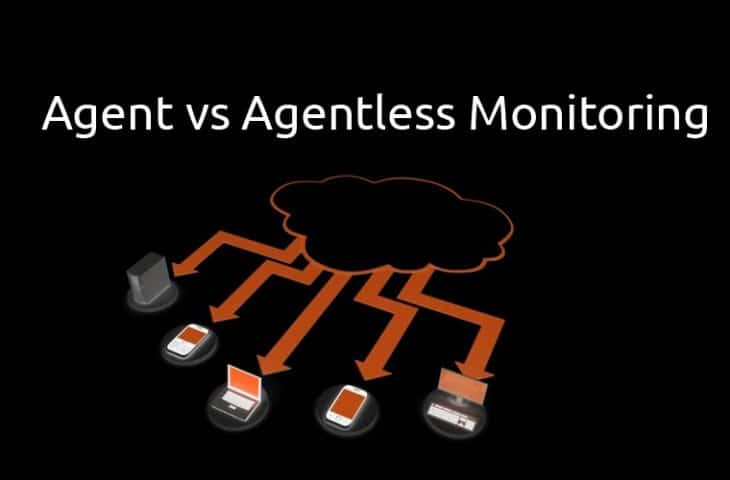
Monitoring IT infrastructure is a critical part of ensuring performance, security, and reliability. Choosing the right approach—agent-based or agentless—can have a significant impact on efficiency, scalability, and visibility. This article provides a detailed comparison of both approaches and their best use cases in 2026.
1. Understanding the Basics
Agent-Based Monitoring
Agent-based monitoring requires installing a small software agent on each server, device, or system being monitored. The agent collects data locally—CPU usage, memory, disk I/O, application metrics, and system logs—and sends it to a central monitoring platform.
Key points:
- Real-time data collection
- Detailed metrics, including custom application-level metrics
- Supports advanced alerts and automation
Agentless Monitoring
Agentless monitoring does not require any software installation on the monitored systems. It uses standard protocols like SSH, SNMP, WMI, HTTP, or APIs to collect data remotely.
Key points:
- Quick and simple deployment
- Non-intrusive for sensitive or restricted systems
- Depends on available system interfaces for data collection
2. Detailed Comparison
| Criteria | Agent-Based Monitoring | Agentless Monitoring |
|---|---|---|
| Deployment | Agents must be installed and maintained on all monitored hosts | No installation required; connects remotely |
| Data Depth & Accuracy | High-resolution, detailed metrics (OS + applications) | Limited to data exposed via protocols |
| Network Load | Low, as data is processed locally | Higher, raw metrics are sent over the network |
| Security | Supports encrypted data collection and policy enforcement | Depends on protocols; requires proper firewall and access configuration |
| Maintenance | Needs regular updates and patches | Low maintenance; no agents to manage |
| Custom Metrics | Fully customizable and extensible | Limited by protocol capabilities |
| Performance Impact | Minimal impact on host | Minimal impact on host; monitoring server may handle more load |
| Scalability | Efficient for large, heterogeneous environments | Can be slower at very large scale; depends on network stability |
3. Advantages and Use Cases
Advantages of Agent-Based Monitoring
- Deep visibility into OS and applications
- Real-time alerts with minimal latency
- Supports automation and complex workflows
- Ideal for high-security environments
Best Use Cases:
- Critical production systems requiring granular insights
- Complex applications with high performance or reliability requirements
- AI-driven anomaly detection and predictive monitoring
Advantages of Agentless Monitoring
- Quick deployment, no software overhead
- Non-intrusive for sensitive or restricted systems
- Simplified maintenance with no patching required
- Suitable for compliance monitoring and auditing
Best Use Cases:
- Temporary or ephemeral systems, such as cloud instances
- Systems where agent installation is not possible
- Lightweight monitoring with minimal operational impact
4. Hybrid Monitoring Approach
In 2026, many organizations adopt a hybrid approach:
- Use agent-based monitoring for critical workloads and systems that require detailed metrics
- Use agentless monitoring for dynamic, temporary, or restricted environments
- This balances visibility, security, and operational simplicity
5. Emerging Trends
- AI & Predictive Analytics: Agent-based metrics enhance anomaly detection and predictive maintenance
- Cloud & Serverless: Agentless monitoring fits ephemeral workloads; agents provide detailed metrics for critical services
- Security & Compliance: Agents allow encrypted, policy-driven collection; agentless monitoring requires strict access management
- Automation: Modern platforms integrate agent data with automated remediation, alerting, and reporting